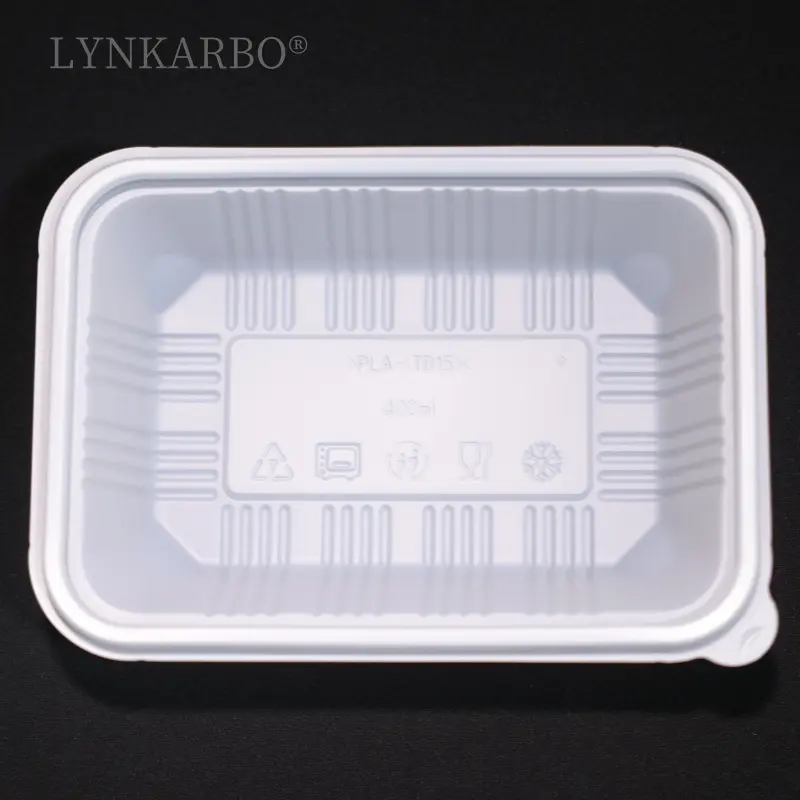
400ml CPLA Disposable Food Container
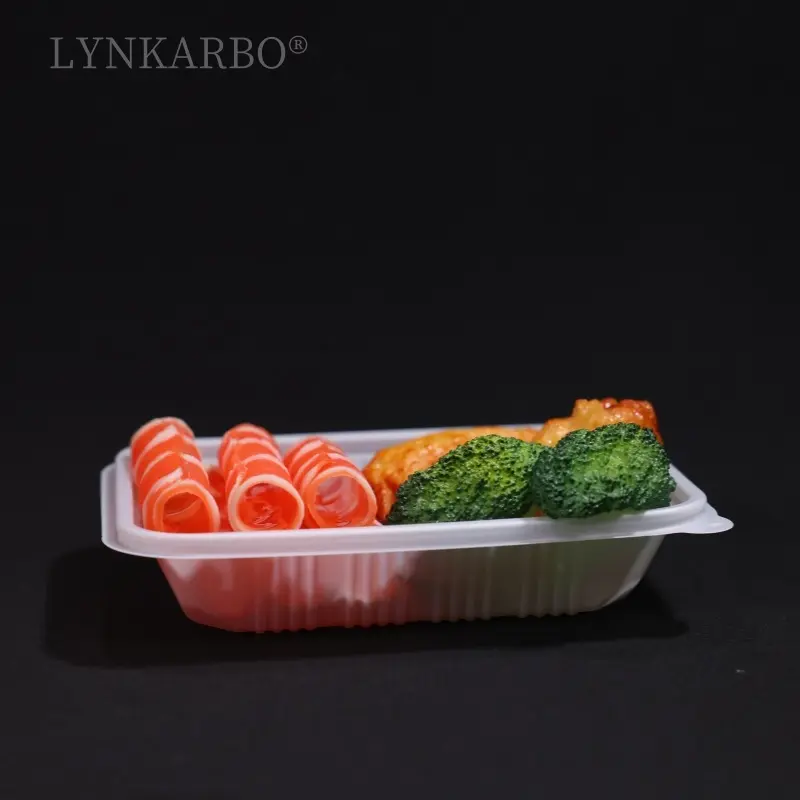
LYNKARBO, a manufacturer of CPLA food containers, supplies 400ml CPLA disposable food container to outlets that need to transport hot meals from the kitchen. This product consists of a thermoformed container body (featuring a single compartment) and a press-to-seal lid; the workflow involves filling the container, securing the lid, stacking, and delivery.
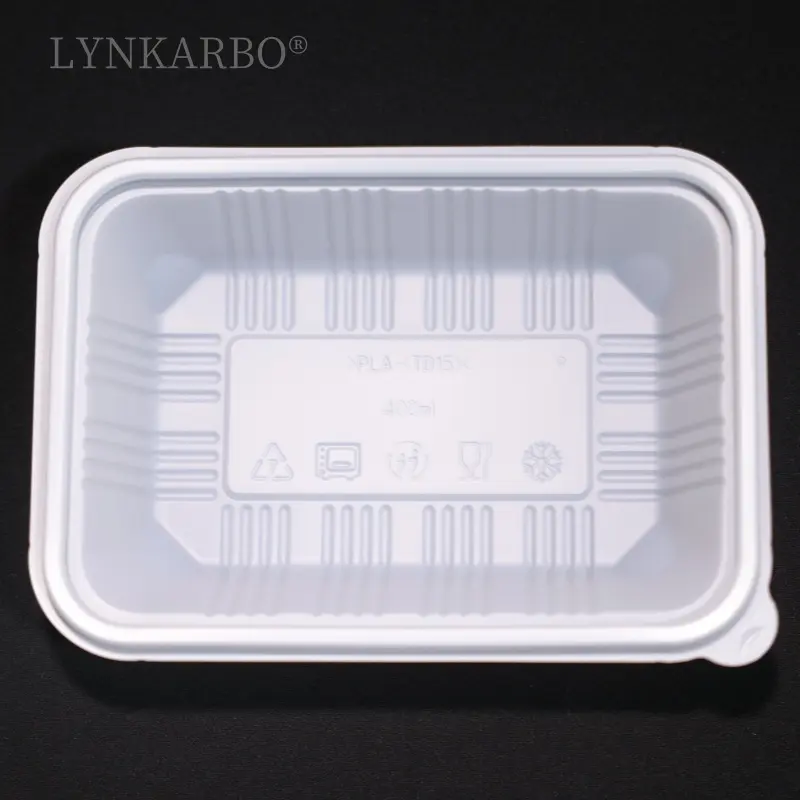
The 400ml CPLA disposable food container is a single-unit product consisting of a container body and a matching lid, thermoformed from CPLA sheet material and sized for a single serving. A single compartment accommodates both the main course and side dishes. The lid snaps securely onto the rim, allowing filled containers to be stacked, bagged, or carried flat without the need for top films, rubber bands, or tape.
How to use this food container
The 400ml CPLA disposable food container is purchased by the thousand but judged one by one by the person holding it. The following five points cover the key factors determining its usability.
Filling temperature takes precedence over all other parameters:
This is the first figure we ask for, as it determines which modified material grade suits your production line. CPLA retains its shape at higher temperatures within the softening range compared to pure PLA, which is why we recommend this grade for hot food.
Snap the lid shut before bagging:
The container rim is set during thermoforming; if a lid won't snap on, it is usually due to an incorrect lid or a warped base. We recommend manually checking the first three containers in a batch rather than relying solely on visual inspection.
Support the base when moving or stacking—do not lift by the rim:
When the base is flat, filled containers can be stacked safely. Lifting a stack of four by the rim is the quickest way to crush the corners, and damaged corners are where seam failures begin.
Allow a brief pause after filling before deep stacking:
Stacking two hot containers fresh off the line directly on top of each other is the worst way to handle the bottom container. Allowing a short interval between filling and stacking costs nothing.
Store flat, dry, and away from direct sunlight:
CPLA molded parts soften when heated; a pallet of product left near a south-facing window can suffer more damage than it would during a full shift on the production line. Keep cartons closed, stacked flat, and out of the sun.
Selection: A Comparative Analysis of CPLA, Pure PLA, and PET
| What you are comparing | CPLA | PLA (plain) | PET |
| Base material | PLA blended with a mineral filler | PLA on its own | Petroleum-based polymer |
| Shape under a warm, heavy portion | Holds its shape further into the softening range | Softens earlier under the same load | Holds shape well |
| Transparency | Translucent, not clear | Can be made clear | Can be fully clear |
| Colour | Natural, undyed, no colour masterbatch | Natural or clear | Clear or tinted |
| Compostability paperwork | Industrial compostability documents are held for our PLA ranges; coverage is issued per product and per thickness | Same position as CPLA | Not a compostable material |
| Our container range | The material we quote for warm food | Used on our cold drink cups and clear sheet | Outside our product range |
| Choose it when | The meal leaves the kitchen warm and the base has to stay flat | The product is cold and the pack has to be seen through | A compostability claim is not required |
Application Scenarios
For the 400ml CPLA disposable food container, six specific application scenarios account for the vast majority of orders; the rationale behind each scenario reveals more about the container's characteristics than its capacity alone.
Delivery-only kitchens and takeout packing stations:
Containers are packed at the station and placed into thermal bags for transport via e-scooter. A flat base and a secure, press-fit lid are the only requirements here, as there is no opportunity to remedy leaks once the order leaves the premises.
Staff canteens and factory group meals:
High-volume usage occurs within a tight time window, with stacks of containers prepared before service begins; the compressive strength of the base determines whether a stack of a hundred meals remains presentable by the time it reaches the serving counter.
Deli and refrigerated counters:
Salads, cold cuts, and prepped side dishes are packed cold and displayed behind glass. The container serves as the vessel, while the display drives sales.
Sushi and small platters:
Compact portions; containers are often carried on trays alongside other items. A secure lid ensures the contents do not shift during the journey from counter to table.
Supermarket ready-to-eat meals and convenience store shelves:
Meals are refrigerated, stacked on shelves, and picked up by shoppers. Uniform base dimensions are more critical than any single functional feature, as shelf restocking relies on machine-loaded trays.
Banquets, buffets, and event catering:
Hundreds of 400ml CPLA containers must be filled within a very short timeframe, often by staff unfamiliar with the product. The ability to press the lid shut without prior instruction makes the difference between a tidy, efficient setup and a chaotic array of open containers.
From Resin Pellets to Packaged Finished Product
Food containers require a deeper draw than cup lids, and this depth makes dimensional control more challenging. Each of the four stages outlined below involves factors that cannot be rectified in subsequent steps.
Modified pelletizing:
PLA-based materials are compounded into pellets on the initial production line. If the filler is unevenly dispersed, the performance of individual boxes within the same carton may vary.
Sheet Extrusion:
Pellets are processed into sheets on the second production line. Thickness must remain uniform across the entire sheet, as the material thins during the stretching process used to form the box body—specifically, a thin strip on the sheet becomes the base—including the deepest corners—of every box cut from it.
Thermoforming:
On the third production line, the sheet is heated and stretched into the box body, including the rim/locking flange. The stretching depth, corner radii, and the locking flange—where the lid snaps shut—are all defined at this stage.
Packaging and Cup Production Line:
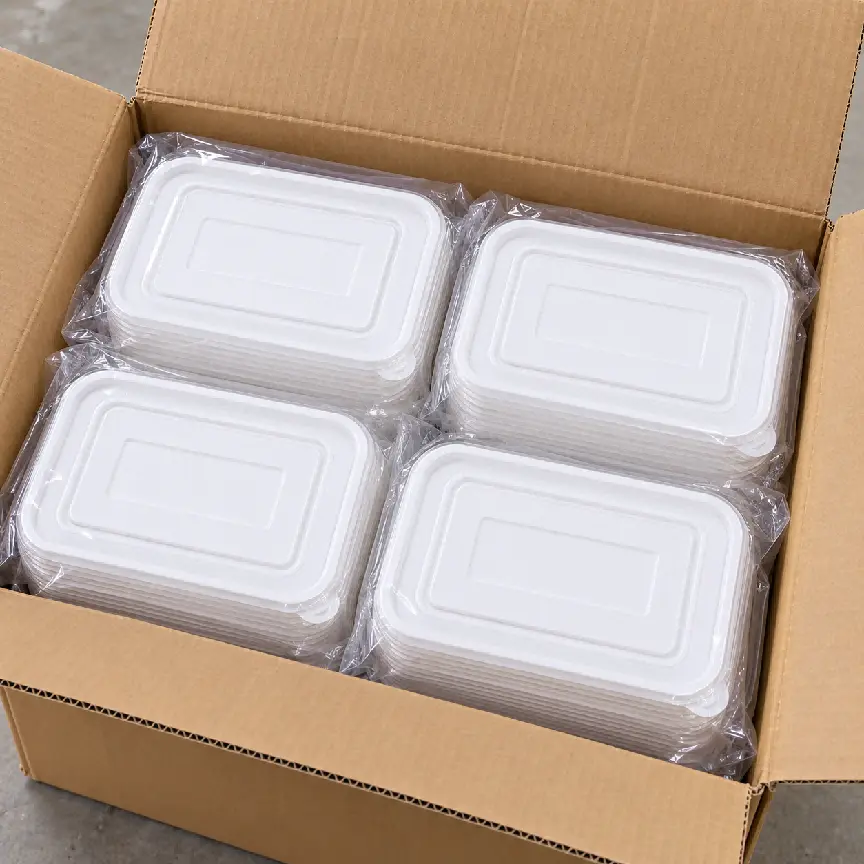
400ml CPLA disposable food containers are inspected and packaged in a cleanroom environment before being boxed and palletized. A fourth production line handles cold drink cups and printing; this capability allows us to quote complete takeaway tableware sets rather than just individual boxes.
FAQ
Q1: What is the actual capacity of the 400ml box? How do I determine if this size is suitable?
A: Please weigh the food; density variations are significant enough that a 400ml portion of one dish might fit comfortably, while another could put pressure on the lid. Send us the dish name, single-portion weight, and filling temperature, and we will advise whether this specification is suitable or if you should move up to the next size.
Q2: Can it hold hot food?
A: Yes. CPLA contains mineral fillers, allowing the base container to maintain rigidity longer as it approaches the softening temperature range compared to pure PLA; this is why we recommend it for hot food.
Q3: Can our customers put the boxes directly into the microwave?
A: Do not assume this is possible. Reheating performance depends on the specific blend formula and heating duration; testing must be conducted based on the specific grade rather than making broad promises across a product series. Please request the technical data for your specific grade from us; if this feature is important to your service, consider printing the information on the packaging.
Q4: What is the minimum order quantity (MOQ)? How long does it take to receive samples?
A: The minimum order quantity is 100,000 units per size and design, though quantities for trial orders and reorders can be lower. We provide free samples prior to order placement so you can verify fit and compatibility with your actual meals, rather than ours. Providing us with your projected annual usage is more helpful than simply stating the volume for the initial order.
Q5: Could the lid come off inside the delivery bag?
A: When snapped onto a flat rim, the lid stays securely in place. There are two factors that could cause it to detach: the base warping due to heat and heavy contents, or the lid not being properly sealed before the container is placed in the bag. Both issues are avoidable, which is precisely why we ask for the weight of a single serving before providing a quote.
Q6: Which certifications cover this meal box?
A: Please request documentation based on the specific product and thickness. Compostability certifications are issued for specific products; a certificate covering one item in a series does not automatically apply to another—this applies equally to cups, lids, and boxes. Just let us know the specific product and thickness you are sourcing, and we will send you the relevant documentation.
Hot Tags:
Send Inquiry
Contact Info
-
Address
No.3, Tianyue Road, Tianbao Industrial Park, Economic Development Zone, Baodi District, Tianjin City, China
-
Tel
-
Email
Want to get the wholesale price, customization quote, or sample of PLA Cold Drink Cup, PLA Lunchbox, or CPLA Lunch Boxes? Please fill in your inquiry information here.

News Recommendations